Anonymous Browsing vs an Account: Trade-offs
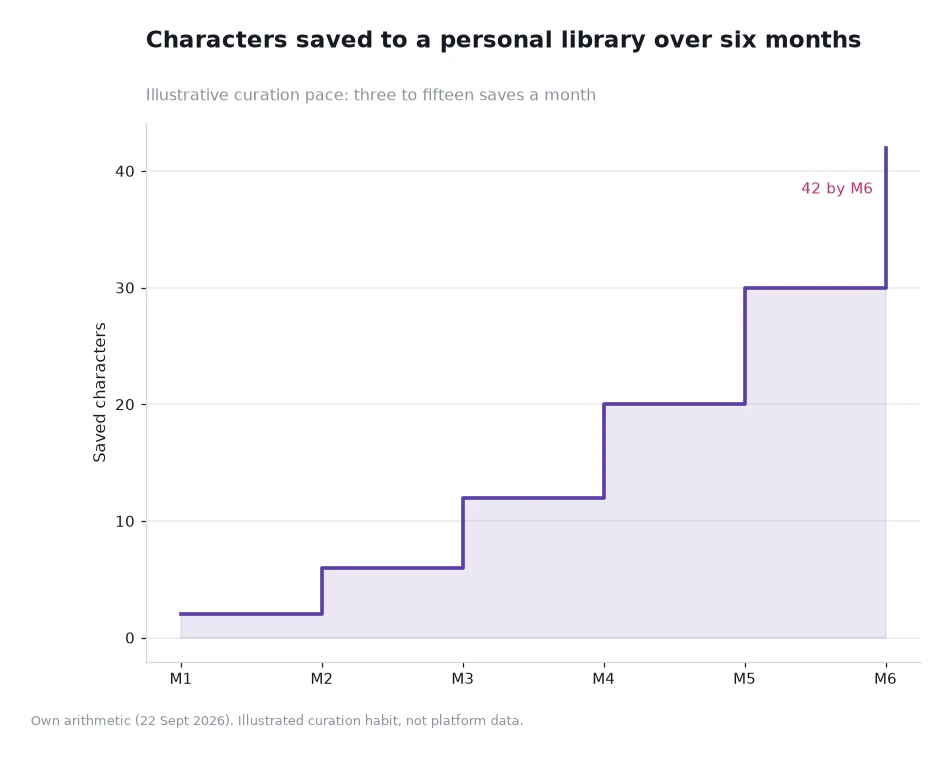
Browsing without signing in answers one question well: is this catalogue worth my time? An account answers a different one: does anything accumulate? The gap is measurable — an illustrative library curve reaches 42 saved characters by its sixth month with an account and stays at zero without one.

Key takeaways
- Browsing gives you the catalogue — trends, weekly rankings, tags and counters all read fine without an account.
- An account is what makes anything persist: saves, a library, and the preference recall the platform describes.
- The cost is a profile of taste rather than a fee in minutes: the more that persists, the more there is to look after.
- Saving is a signal you contribute to, not just consume — favourites sit at 7.1K against 24.3M views on the leading card, about 0.029%.
What browsing decides, and what it cannot
Read-only browsing is genuinely useful. The trends page, the weekly rankings, the tag rows and the two counters on every card are all available to a visitor who never signs in, which is enough to judge whether the catalogue matches your interests at all.
What browsing cannot do is remember. The persistence the platform describes — companions that remember your preferences and adapt over time — needs a place to store the preferences. Without an account there is no library to save into, no favourites to contribute to, and no history for a character to draw on when you return to it a week later.
That is the whole trade in one sentence: browsing is a reading room, an account is a desk. You can learn a great deal in a reading room, but nothing follows you home.
The trade in each direction
Signing in buys continuity. Saves survive, a shortlist survives, and the second session with a character starts from what the first session established rather than from nothing. It also lets you contribute the two signals the catalogue is built on: a favourite is a deliberate save, and it is the rarer and more informative of the pair.
The other side of the ledger is what accumulates about you. An account is a record of taste, and any record deserves the same care as the conversations that produced it. The platform's own description is a private and secure environment with state-of-the-art encryption; that is a solid claim and the right one to rely on, without stretching it into something stronger.
A useful test before choosing either way: note how many characters you would genuinely want to come back to. If the honest answer is one or two, browsing with a bookmark does the job; if it is a dozen, an account is doing real work rather than merely collecting a profile.
Browsing carries a different cost, which is mostly repetition. Without a library, every month starts with the same discovery pass, and the only way to remember a good character is to keep the tab open or write the name down somewhere outside the platform.
A third option: browse first, sign in for one
Most readers settle on a middle path without naming it. Browse freely until a character earns a second visit, then create an account and save that single card. The library begins at one entry instead of forty-two, and preference recall has something specific to work with from the outset.
Crushon's structure suits that approach. The navigation splits into Characters, Memories and Creators, and cards on the trends board carry a creator credit, so a character that works can be traced back to whoever published it and to the rest of their work.
A one-entry library is also easy to abandon if the platform turns out not to be for you. Starting small keeps the second decision — whether to stay signed in at all — cheap in both directions.
The version to avoid is signing in for curiosity and letting a library grow faster than you revisit it. That produces the same maintenance job as a large collection with none of the payoff, because none of the entries was chosen on purpose.
| Capability | Browsing only | With an account |
|---|---|---|
| Trends board and weekly rankings | Fully readable | Fully readable |
| Tag rows and card counters | Visible on every card | Identical |
| Favourites you contribute to | Not possible | Counted and shown on the card |
| Saving a character | Nothing to save into | Library grows, 2 to 42 over six months in the curve below |
| Preference recall | No history to draw on | Persists between sessions |
| A second surface | One browser session | Browser plus the mobile app |
Worked example: what persistence is worth in counts
Take the illustrative curation curve used in the chart below: two saves in month one, then four, six, eight, ten and twelve added in the months after. Read as a running total it goes 2, then 2 + 4 = 6, then 6 + 6 = 12, then 12 + 8 = 20, then 20 + 10 = 30, then 30 + 12 = 42.
With an account the library finishes the half-year at 42 entries. Without one it finishes at zero, because there was no library to add to, and the same six months of browsing produce the same six months of re-discovery.
The count has a second use. Forty-two saved characters is a substantial list to keep tidy, and a two-minute review per entry is about 84 minutes to skim the whole library once. That is the hidden cost of the trade: persistence saves you work at the front of the month and creates a small maintenance job at the back of it.
Reading the official page in the right order
The ai porn chat page sets out three claims worth comparing against your own priorities: customizable characters with their own personalities and interaction styles, privacy and discretion, and responses that recall previous interactions and adapt over time. Only the third one requires persistence, and it is the one an account unlocks.
The same page answers the terminology question in its FAQ, where Porn Chat AI and AI Porn Chat are used as names for the same category rather than two products. Reading it once is enough to know what you are signing in for, which is a better basis for the decision than the pull of a favourites counter.
Two further pages are worth knowing before you commit either way. The 2257 compliance statement confirms that the content is AI-generated text and depicts no real person, and the character search page shows how much of the catalogue a visitor can already reach without an account.
Frequently asked questions
Can I judge the catalogue without an account?
Yes. Trends, rankings, tags and counters are all readable by a visitor, which is enough to decide whether the catalogue suits you.
What does an account actually add?
Continuity. Saves, a shortlist and the preference recall the platform describes all depend on something persisting between sessions.
Does an account change the privacy position?
It changes what persists, not how the chat experience is built. The platform's wording remains a private and secure environment with state-of-the-art encryption.
Decide on the second visit, not the first
Browse first, and treat the first visit as reconnaissance rather than commitment. If you come back within the same week and want the same characters again, that returning interest is the real argument for an account — and if you do create one, spend the first session pruning rather than collecting.
Data and sources: the product claims, FAQ wording and catalogue structure published on CrushOn.AI[1], read 22 Sept 2026. The six-month save curve and the two-minute library review are illustrative assumptions, not platform data. Intended for adult readers of 18 years or older.