Sourcing consumer products from China works best when the product brief, supplier quote, approved sample, production checks, and shipping documents all refer to the same revision. Buyers should define requirements and decision owners early, compare full commercial scope, and resolve destination-market import responsibilities before goods are dispatched.
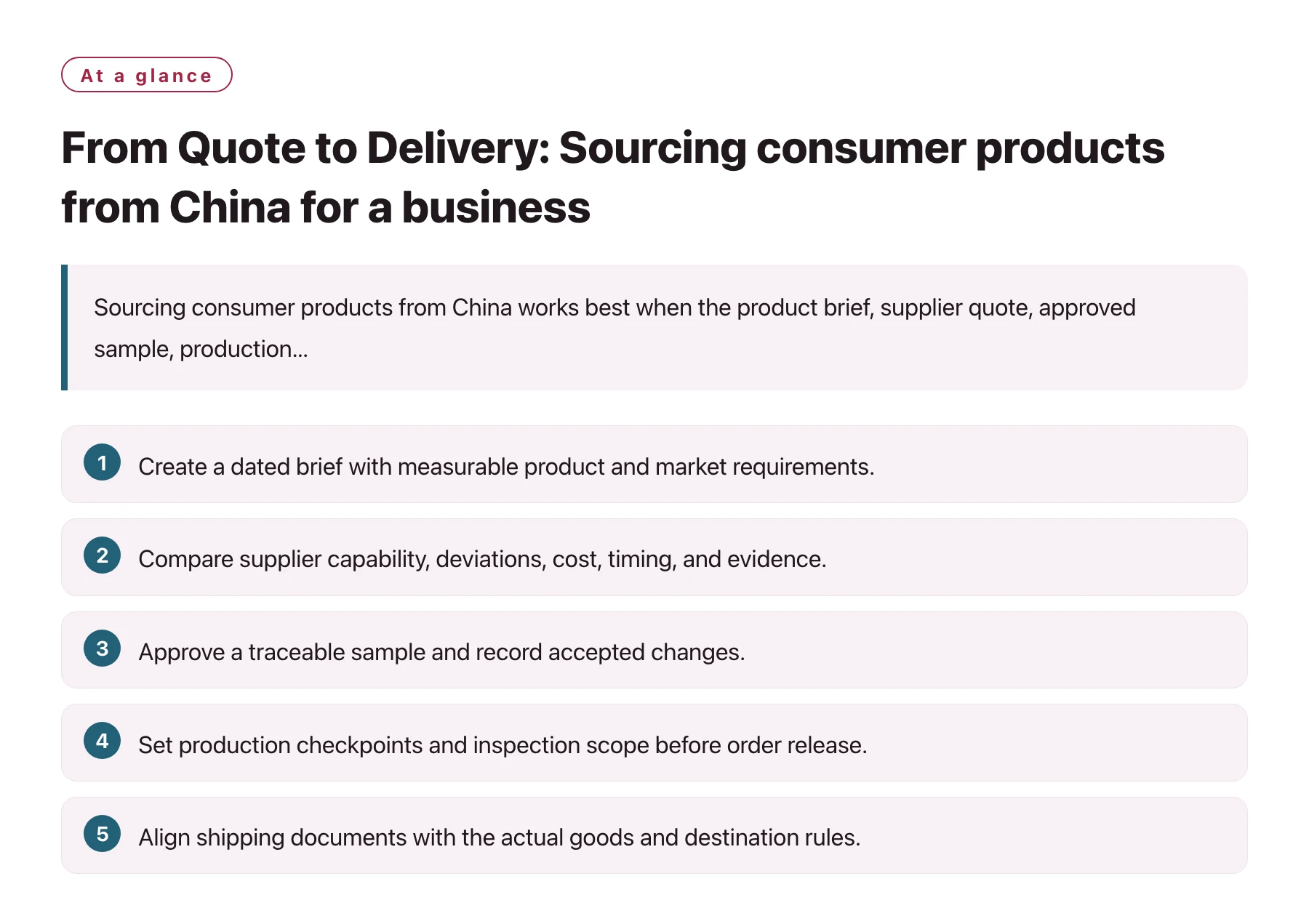
Key takeawaysCreate a dated brief with measurable product and market requirements. · Compare supplier capability, deviations, cost, timing, and evidence. · Approve a traceable sample and record accepted changes. · Set production checkpoints and inspection scope before order release. · Align shipping documents with the actual goods and destination rules.
A sourcing project can lose time when commercial, product, and logistics teams each rely on a different version of the order. These stages create a shared handoff from the first quote through receipt.
Turn the product idea into a controlled brief
Start with the buyer, channel, and use case. Record who will use the product, where it will be sold, the expected order quantity, target launch window, and which features are essential. Separate must-have requirements from preferences so suppliers can quote a consistent baseline while offering clearly labeled alternatives.
Describe the product with drawings, dimensions, materials, colors, function, packaging, labeling, and included components. For private-label goods, specify artwork ownership and approval steps. State applicable destination-market requirements and ask a qualified compliance owner to determine which tests, registrations, warnings, or certificates apply. Product category and country can change those obligations, so a factory quotation alone does not establish import readiness.
Assign a revision number and date to the brief. Send one copy to each supplier and ask them to return deviations and questions in writing. This makes later sample and quotation comparisons traceable to the same requested configuration.
Screen suppliers and compare commercial offers
Build a shortlist around product capability and evidence. Ask each candidate to identify its role as manufacturer, trading company, or other intermediary; relevant product lines; production location; subcontracted steps; quality controls; and experience with the requested configuration. Request documents that are meaningful for the category and verify that names, addresses, model references, and dates are consistent.
Compare total scope rather than headline unit price. Include tooling, samples, packaging, inspection, spare parts, minimum order quantities, production lead time, payment milestones, freight assumptions, and exclusions. Ask what is included in the quote and which price changes if quantity, material, artwork, or delivery terms change. Clarify who owns molds and approved artwork, and how they can be accessed if the relationship ends.
Create a comparison sheet with requirement, supplier response, evidence, deviation, cost effect, timing effect, and open owner. Mark unverified claims as open questions instead of treating them as facts. A supplier that requests clarification may help surface a weak specification before it becomes an expensive order change.
Approve a sample before production release
Define sample type: stock sample, altered reference sample, or production-equivalent sample. Record model, options, material, finish, dimensions, labels, packaging, and revision. Evaluate function and workmanship against explicit criteria, and use measurements or specialist tests where a visual check is not adequate. Capture photographs with a ruler or identifier when size and configuration matter.
Document each correction and request a revised sample if the change affects fit, safety, performance, appearance, or assembly. The final approval should point to a specific sample code and revision. Keep a retained reference where practical, and write the accepted tolerances into the purchase documents so production teams know what may vary.
Do not let an informal message replace sign-off. Identify who can approve the sample and who can approve a technical deviation. If production must begin before a detail is resolved, list that item as a hold point and define what cannot proceed until approval is received.
Plan production checkpoints and shipment evidence
Break the order into milestones: purchase confirmation, material readiness, initial production, in-process review, final inspection, packing, and dispatch. Choose checkpoints based on product risk and the cost of late discovery. Ask for evidence tied to order number, lot, model, and revision. Establish how defects are documented, how corrective action is approved, and who may release goods.
A pre-shipment inspection can report the inspected sample, observed dimensions or functions, visible defects, quantities, and package condition within its assigned scope. It does not automatically prove every unit conforms or that all destination regulations are satisfied. Define sampling methods and acceptance criteria with the quality owner, and use accredited or specialist testing when the product requires it.
Agree on the documents needed for the destination country before production finishes. The U.S. Department of Commerce recommends asking the foreign buyer early about documents needed to clear goods; its guidance also describes special documents that can depend on the product and importing market.[1] Keep commercial invoice, packing list, transport documents, origin records, and category-specific paperwork aligned with the final goods and responsible issuer.
Coordinate shipping and import responsibilities
Choose the delivery term and transport plan with the importer, supplier, freight forwarder, and broker. Clarify which party arranges pickup, export clearance, freight, insurance, destination handling, and final delivery. Confirm carton dimensions, weights, pallet pattern, cargo readiness date, booking cutoff, and who approves changes to the shipment plan.
The importer should determine the applicable entry, classification, valuation, permits, and agency requirements for its own destination. CBP advises importers to review commodity-specific requirements and requirements of other agencies; product type can affect what permits or certifications apply.[2] Use a licensed customs broker or qualified trade specialist when appropriate, but agree who supplies accurate product and transaction data and who reviews the entry documents.
Before dispatch, reconcile purchase order, final quantity, carton marks, packing list, invoice, and transport instructions. Check that the supplier has not shipped unapproved substitutions or mixed lots. Preserve the final approved files and communicate any exception to the importer and broker before the cargo moves.
Close the loop from delivery to reorder
At receipt, compare delivered quantities and condition with the order. Record shortages, damage, incorrect labels, or configuration differences by carton and lot. Photograph evidence before repacking or using affected products, then follow the agreed claims and containment route. For a high-impact issue, pause distribution until the product owner decides what happens next.
Review actual lead time, defects, documentation accuracy, packaging performance, and communication against the original supplier scorecard. Note whether delays came from specification changes, sampling, materials, production, booking, or customs documentation. Use the review to improve the next order rather than relying on memory.
For buyers seeking sourcing consumer goods for importers, supplier coordination can cover shortlist research, quote comparison, sample follow-up, production communication, or inspection planning. Define those deliverables and decision rights before work begins; the buyer’s designated owners remain responsible for product acceptance, compliance, import declarations, and commercial release.
Sources
Frequently asked questions
When should import documents be discussed with the supplier?
Before production is complete. Confirm destination requirements and document owners early so product-specific records, invoices, labels, and packing details can be prepared in time.
Does approving a sample guarantee every production unit will match?
No. It establishes a reference. Production controls, inspection criteria, change approval, and lot traceability are needed to assess the delivered order.
Who is responsible for destination import compliance?
The importer should identify applicable rules and provide accurate data, using qualified brokers or specialists where needed. Supplier support does not replace the importer’s decisions.
What should a supplier comparison include besides price?
Include configuration, evidence, deviations, samples, tooling, packaging, minimum quantities, lead time, inspection scope, payment terms, and freight assumptions.