Sample drift is a fact of perfumery rather than a failure of the supplier, and the decision that matters is not whether drift exists but whether the sample in front of you is close enough to approve. A workable approach is a three-way choice: approve against a retained reference, hold and re-test at a defined date, or send the sample back with a written question. The framework is useful because it forces the comparison to rest on evidence instead of on the launch calendar.
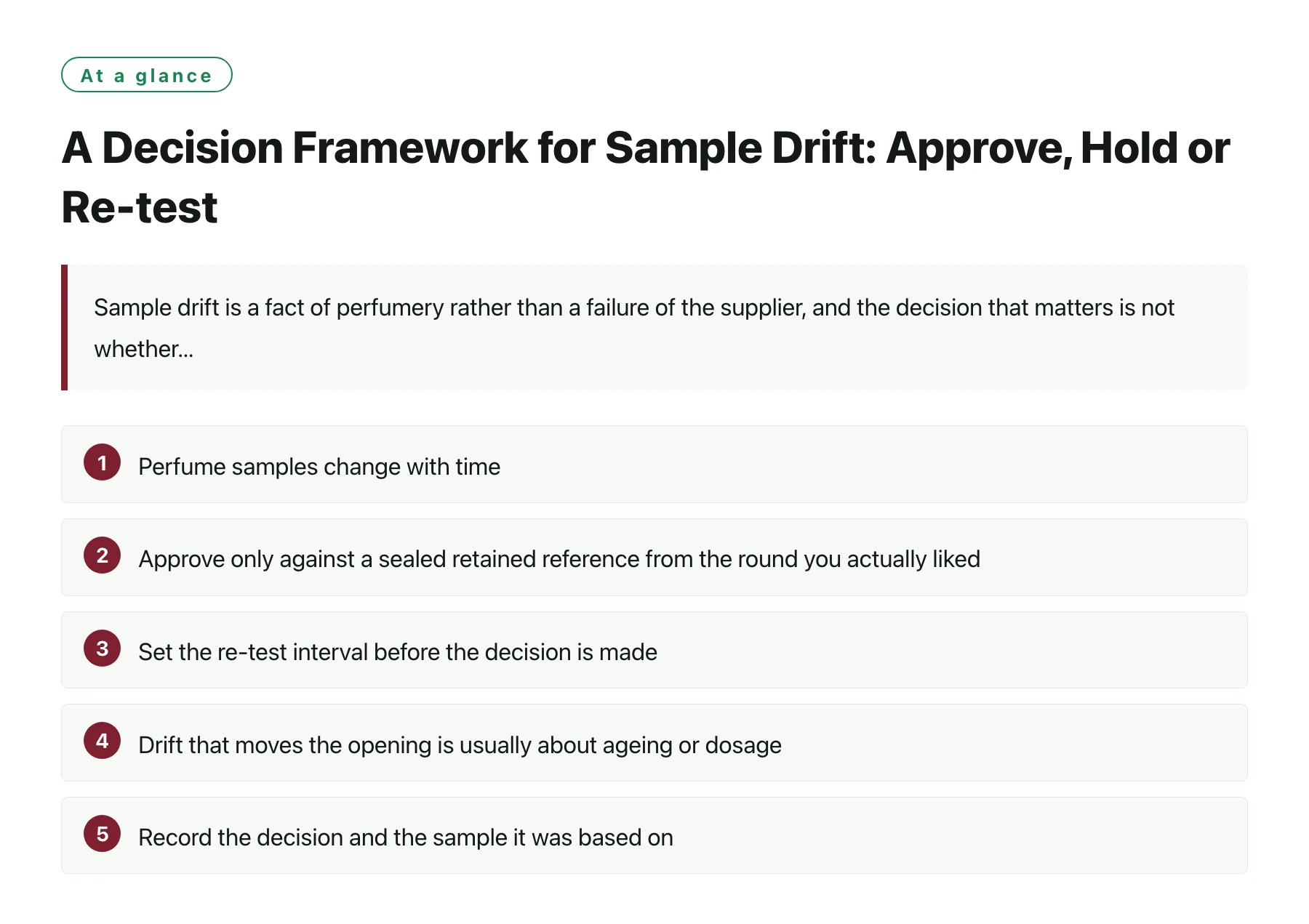
Key takeawaysPerfume samples change with time, temperature and dosage, so a difference between two rounds is not automatically a defect. · Approve only against a sealed retained reference from the round you actually liked, never against the newest sample alone. · Set the re-test interval before the decision is made, so that giving it another month becomes a date rather than an intention. · Drift that moves the opening is usually about ageing or dosage; drift in colour, clarity or texture is a question for the factory. · Record the decision and the sample it was based on, because a launch decision that was never written down will be argued about later.
The third sample arrives. It is close to the first one, but the opening is sharper and the drydown is thinner, and nobody on the team can agree whether that is a real change or a difference of opinion. This is the ordinary situation that stalls small fragrance projects, and it is a decision problem more than a technical mystery.
The framework below is written for a buyer or product developer who has to make that call without a perfumery laboratory of their own, and who needs an answer that can be defended three months later.
Why samples drift in the first place
A sample is a snapshot of a formula at a particular moment. Between the bench and the bottle, the concentrate and the finished product keep reacting: alcohol and water content equilibrate, heavier molecules redistribute, and some materials change perceptibly over weeks. Storage conditions and the dosage used in each round add their own variation.
None of that is automatically the supplier's fault. What is the supplier's responsibility is knowing how a formula behaves over time and telling the buyer what to expect. What is the buyer's responsibility is deciding what tolerance is acceptable for the product being sold.
Drift is also not uniform across a fragrance. The opening notes are built from smaller, more volatile molecules and tend to move first. Base notes often become more blended and, to many noses, more pleasant. A sample that smells different may simply be on a normal trajectory, or it may be off it, and separating the two is the whole job.
Understanding perfume sample aging makes that first judgement easier, because it turns a vague impression into a question about time, dosage and storage. It also helps to know that fragrance materials are assessed for safe use in the finished product, which is why dosage and product category matter as much as the smell itself [1].
A three-way decision, by symptom
| What you observe | Likely driver | The decision to take |
|---|---|---|
| Sharper opening, similar drydown | Normal ageing or a small dosage difference | Hold and re-test at the agreed date, against the retained reference |
| Scent is weaker overall | Dosage, fill variance or an older sample | Request the dosage record first; if it matches, judge against the reference |
| Colour, clarity or texture has changed | Stability or a packaging interaction | Do not approve; ask for a stability statement and a fresh sample |
| The difference appears only after storage | Shelf-life behaviour that must be documented | Re-test under defined conditions and record the result in the specification |
| Two noses disagree, repeatedly | The reference itself has drifted between you | Reset the reference: choose one sealed sample, date it, and compare against nothing else |
| The new sample seems better than the reference | The reference has aged beyond its useful window | Retire the old reference, create a new one, and record the change |
The table is not a substitute for the factory's technical opinion. Its purpose is to make sure the question you send them is specific enough to answer.
Running the three-way decision
- Pull the retained reference firstNo comparison starts until the sealed sample from the round you approved is on the table, labelled, and in the same condition as the new one.
- Judge both under identical conditionsSame temperature, same application method, same reading time. A difference in presentation will produce a difference you then have to untangle.
- Describe the change before explaining it'Sharper opening, thinner drydown' is usable information; 'not the same' is not, and it invites the wrong answer.
- Choose one of the three outcomesApprove against the reference, hold with a dated re-test, or send it back with a written question about dosage and ageing.
- Record the decision and keep both samplesNote the date, the batch and who decided. The next conversation about this scent should start from evidence, not from recollection.
Where the factory has to be involved
When the answer is technical
Dosage records, the ageing period before filling, and any stability work already done on the formula are the three documents that settle most drift arguments. A manufacturer that offers fragrance manufacturing under one roof normally holds all three, and asking for them is not an accusation.
Stability and compatibility testing is standard practice in cosmetics, and fragrance is usually assessed as part of that programme rather than separately from it [2]. If a sample passes the smell test but has never been through storage testing, the sensible decision is to hold rather than approve.
When the answer is commercial
Extra sample rounds cost money and calendar time, so the number of rounds included, and the price of additional ones, should be agreed before the project starts. A buyer who discovers the cost of round four during a launch week has lost the negotiating position that mattered.
It is also worth asking, in advance, what happens if the approved reference and a later batch cannot be reconciled. Knowing that the questions to ask a perfume factory include change control and reference retention is a reasonable expectation to set on the first call.
When the answer is patience
Some drift resolves itself. A concentrate that is a few weeks older, or a finished product that has rested longer before filling, can move back towards the reference rather than away from it. If the launch date allows it, a dated re-test is often cheaper than a rework.
The discipline is to make the waiting explicit. A hold with no date is an indefinite delay, and indefinite delays are how a two-month drift becomes a six-month project.
Sources
- IFRA: Safe Use and Fragrance Science —— IFRA's explanation of how fragrance materials are scientifically assessed for safe use and how those conclusions are applied by the industry.
- SGS: Cosmetics, Personal Care & Household Testing —— Testing, inspection and certification services for cosmetics and personal care, including microbiological, stability and safety testing aligned with cosmetics GMP.
Frequently asked questions
Is sample drift always the manufacturer's fault?
No. Some movement is inherent to the materials and to time. The manufacturer's responsibility is to know the trajectory and warn you; yours is to set the tolerance.
How long should we wait before re-testing a drifting sample?
It depends on the formula, but two to four weeks is a common interval for a noticeable ageing effect. Fix the date when you decide to hold, not afterwards.
Should we approve if the new sample is better than the reference?
Only after checking whether the reference has aged out of its useful window. If it has, create a new dated reference and record why the old one was retired.
Who should keep the retained reference?
Both sides, stored under the same conditions. A reference held only by one party is not evidence in a disagreement.
What if the factory says the difference is within tolerance?
Ask what the stated tolerance is and how it was measured. A tolerance that cannot be described in writing is an opinion, and opinions are not a specification.